
Is Your Approach to Peak Performance Really Working?
There’s a simple, yet thought-provoking, equation that many authors and coaches use to determine performance. I first learned it from the book series “The Inner Game” by Timothy Gallwey, a renowned author, mindfulness meditation teacher, coaching genius and former captain of the Harvard University Tennis Team. He explains that…

Let’s break each of these down together so we’re on the same page. We’ll start with the definitions, then go into how they relate to being an athlete.
First up, POTENTIAL. Potential is the capacity someone has to perform at a higher level than they currently do. When athletes think about how to reach their highest potential, the physical side usually comes to mind first… they think about their speed, acceleration, dexterity, hand-eye coordination, etc. However, another important (and overlooked) part is that your brain and mind have potential too. Ever heard of the phrase “your mind is a muscle”? It’s commonly used to explain that both the brain and muscles can strengthen and improve with use. So, when you think of potential on the mental side, you can think of your awareness, concentration, presence, confidence, compassion, resiliency, stick-to-itiveness, etc.
Next, we have DISTRACTIONS. Distractions are anything that prevents you from giving your full attention to something else. Most athletes think of the external distractions first: the opponent, crowd, weather, random noises, field/court/track/ice imperfections, etc. Then, after some prompting, they realize that there are many internal distractions too. Here are two types of internal distractions.
1) Internal (mental) distractions, like your [often judgmental] inner voice and your emotions. Some common inner voice one-liners are: “How did I mess that up?!”, “I don’t want to let my team down”, or “coach is watching so I have to do this perfectly”. As for emotions, they themselves aren’t what mentally distract us. It’s the storylines we attach to them that really pull us away from the present. Fear, doubt, nerves, anxiety, etc. are all natural and okay! However, they end up distracting us when we haven’t learned how to accept and work with them.
2) Internal (somatic) distractions, or body sensations. This can be tightness in your chest, heaviness or shakiness in your arms and legs, a lump in your throat when trying to talk, or muscle aches and cramps.
Every athlete reacts differently to these different distractions. Some handle external distractions well but struggle with internal ones, and vice versa. At the end of the day, they are all distractions and take you out of the present moment. So, we gotta build some mental muscle to make sure they don’t subtract from our potential too much.
Last is PERFORMANCE. Performance can be defined as how effective you are at carrying out a task or behavior to achieve a desired result. It’s the actual execution part and how consistent you are at it. As athletes, and humans, we’re always trying to find ways to improve and optimize our performance. We go all in on finding ways to maximize our performance. From precise data tracking and analytics, to wearable technology, to unconventional training methods… maybe it’s safe to say we’ve become overly obsessed with performance?
So, based on some simple math, your potential and your distractions can both impact your performance. Check this out… Let’s say your potential increases, and your distractions increase by the same amount. Your performance actually remains the same.

Okay, now how about this… Let’s say your potential stays the same and your distractions decrease. What happens? Your performance actually improves! Hmm, I was never taught that as a younger athlete.

Many athletes (and admittedly my younger self) are taught how to optimize their performance by solely focusing their attention and energy on the physical component. They’re taught to work tirelessly on getting faster, stronger, quicker, more skilled, and more technically sound.
You can’t blame them either. This is how our society, culture, coaches and parents may have taught us to improve. Athletes are often told to DO MORE… more reps, more training, more practice, etc. Turns into a constant PUSH HARDER vibe… “Lift heavier weight”, “put in more effort”, “keep going ‘til failure”. While they’re spending most of their time training their bodies, they’re ignoring the fitness and conditioning of their minds.
I was surrounded by this philosophy my whole athletic career. There were days I’d be hitting baseballs off a tee (both before and after team practice) until my hands bled. Other days where I ran until I got sick. There were also countless 6:30 am weightlifting sessions (after barely enough sleep), and the back-to-back road trips for away games while somehow trying to find time to finish my homework. Like many others, I thought this was my recipe for success and accomplishing my goal of playing D1 baseball. I had dreams of playing pro ball too! In retrospect, it’s very possible that this approach resulted in needing micro-fracture knee surgery during my senior year of high school. Fun times in the pic below.

In addition to the excruciating physical pain, I really suffered mentally. I cried (several times) from the fear, doubt, angst and uncertainty that came along with the injury recovery process. These responses to my situation were completely normal, however, they turned into debilitating distractions and I didn’t have the mental skills to work through it. Thankfully my parents were there to support me. They never pushed the “do more, work harder” message at me. Instead, they were always compassionate and supportive, and I’m very grateful for that. Unfortunately, this isn’t always the case for many athletes, and they need the same type of support and care. That’s why, per request of coaches and our own observations, we are planning to open a sector of bmindful specifically for parents.
Anyway, don’t get me wrong, some elements of the “do more, work harder” approach can be beneficial. A few basketball greats immediately come to mind such as Kobe, MJ, and Lebron. The greatest gymnast of all time, Simone Biles, is also someone who pops up when thinking about athletes that put everything they have into their training sessions. I think it’s fair to say that “the grind”, dedication and consistency definitely helped them achieve their success. However, the physical reps are not everything that these elite [and arguably GOAT] athletes focused on. They also put many, many hours into training their minds and learning how to work with distractions.
During bmindful team sessions, we often show this Calm commercial…where Lebron wisely states, “while the greats master the body, the greatest master the mind.”

The more present (mindful) you are, the less distractions there are. According to Gallwey’s equation, the less distractions there are, the more your potential can shine through and the better your performance will be. It’s a very simple equation, however, it’s hard to figure out the key to minimizing distractions. This is where mental muscle building comes in.
“As much as we pump iron and we run to build our strength up, we need to build our mental strength up, so we can focus, so we can be in concert with one another.” - Phil Jackson
Focusing on the mental side is often neglected in sports, partly because it isn’t as straightforward as lifting weights in the gym. Many coaches struggle to find tangible ways to train the mind or don’t have enough hours in the day to even get to talking about the mental side. This gap is one of many reasons why we started bmindful 6 years ago.
All this being said, over the past few years more attention is being placed on the mental side of the game. Mindfulness and mental training at the professional and top-tier collegiate level are becoming more of a priority and even the norm. More and more coaches/organizations are seeing the impact it makes on an athlete’s performance, quality of life, and general health. There have also been tens of thousands of articles published about mindfulness in sports (two-thirds of them occurring in the last five years of that period).
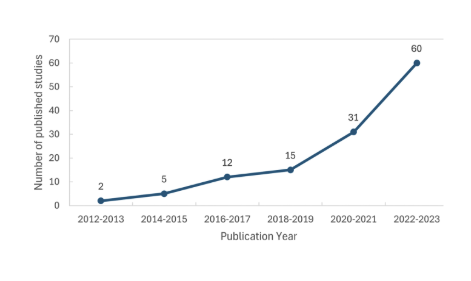
More than 2,500 meditation apps have launched since 2015, with the number of app users tripling since 2012. Lastly, there is plenty of science to back the efficacy of mindfulness on athletic performance. Studies show that a consistent mindfulness practice can even reshape different parts of your brain! Seems pretty clear that there’s a broader cultural shift in the athletic population.
So how do we keep up and where do we go from here? Well, it starts with awareness and honesty. Take some time to ask yourself: “How well am I able to handle distractions during competition and in my daily life? Do they get in the way of my ability to perform and enjoy what I’m doing?” If so, that’s okay… you’re definitely not alone.
Next, take a step back and reevaluate your approach to performance. Write down what your performance equation looks like. Can you think of any moments where you’re pushing to DO MORE on the physical side and neglecting the mental side? Maybe there are opportunities to be curious and shake things up. A question we pose to our clients is: “How can you replace the 5 minutes on social media with 5 minutes of working on your mind daily?”
I want to conclude by saying IT’S OKAY if distractions get in the way. They will. It’s part of the process. What really matters is how we handle them. Try to be kind to yourself and remember that every day is a fresh start, and every distraction is an opportunity to work on your mental strength (awareness, presence, and self-compassion). When we look at distractions from this perspective, we can even learn to be grateful for them. They provide us with the building blocks towards achieving peak performance.
The beauty of mindfulness in particular is that every moment is a moment we can practice working with our distracted mind and create more space for our potential to shine through. And like Lebron says, it might even be that edge that separates you from the rest. If you’re curious about how to begin developing that edge and finding joy throughout the process, we’re here for you :)
- Coach Eric
Sources:
performance. (2025). In Merriam-Webster Dictionary. https://www.merriam-webster.com/dictionary/performance
potential. (2025). In Merriam-Webster Dictionary. https://www.merriam-webster.com/dictionary/potential
distraction. (2025). In Merriam-Webster Dictionary. https://www.merriam-webster.com/dictionary/distraction
Google Search. (n.d.-b). Creswell, J. D., & Goldberg, S. B. (2025). The meditation app revolution. American Psychologist. https://doi.org/10.1037/amp0001576
Mindfulness can literally change your brain. (2015, January 8). Harvard Business Review. https://hbr.org/2015/01/mindfulness-can-literally-change-your-brain
