Mentally Spiraling Out of Control?
A question we are consistently asked by our athletes is: How do I stop my mind from spiraling out of control into negativity?
Some people don’t love our answer: Learn to ride it. Think about what happens when you try to force your mind to stop spiraling… you only feed the spiral. What we try to push away only comes back stronger and with a vengeance.
The same goes with difficult emotions. The more we avoid them, the more headspace they end up taking up.
So we are left with only one other option: embrace the spiral and learn to dance with it. As uncomfortable as it is to be with a mind that is free falling into despair, consumed by fear, and in what feels like never-ending worry… our only effective choice is to address the discomfort in a friendly way. These spirals aren’t going anywhere. Our resistance accelerates them. The one thing that is in our control and that we can change is how we respond to them.
In order to best understand how to respond to this debilitating phenomenon, let’s look at what causes it to arise and how it affects us. The downward spiral begins when the mind begins forming negative storylines in our head in response to high stress scenarios or when it perceives danger (i.e. I may lose this match and I’m going to let my team down!). The more we attach to these negative storylines, the more we feed the spiral and the harder it is to mentally let go of it. Sometimes that storyline is that you are in a life or death scenario… which you are not. No, the world will not end if you lose this soccer game. All of your friends and family will not abandon you. If they do, they’re schmucks. Find other friends.
Of course it might be a little tougher to find a new family, but… you can rely on the bmindful family :)
Biologically, what is occurring in these moments is your sympathetic nervous system is activating the fight-or-flight response. The role of this response is to help prepare your body to survive an immediate threat. An example is if you find yourself 10 feet from a black bear. Living in Colorado and spending many hours in the mountains, I have found myself in this situation before and it has initiated my fight-or-flight response: my heart rate increases to help increase blood flow to my most important muscles, bronchioles in my lungs dilate to allow more oxygen in, my digestive system shuts down to conserve energy, and if I really have to go number 2, that suddenly goes away.
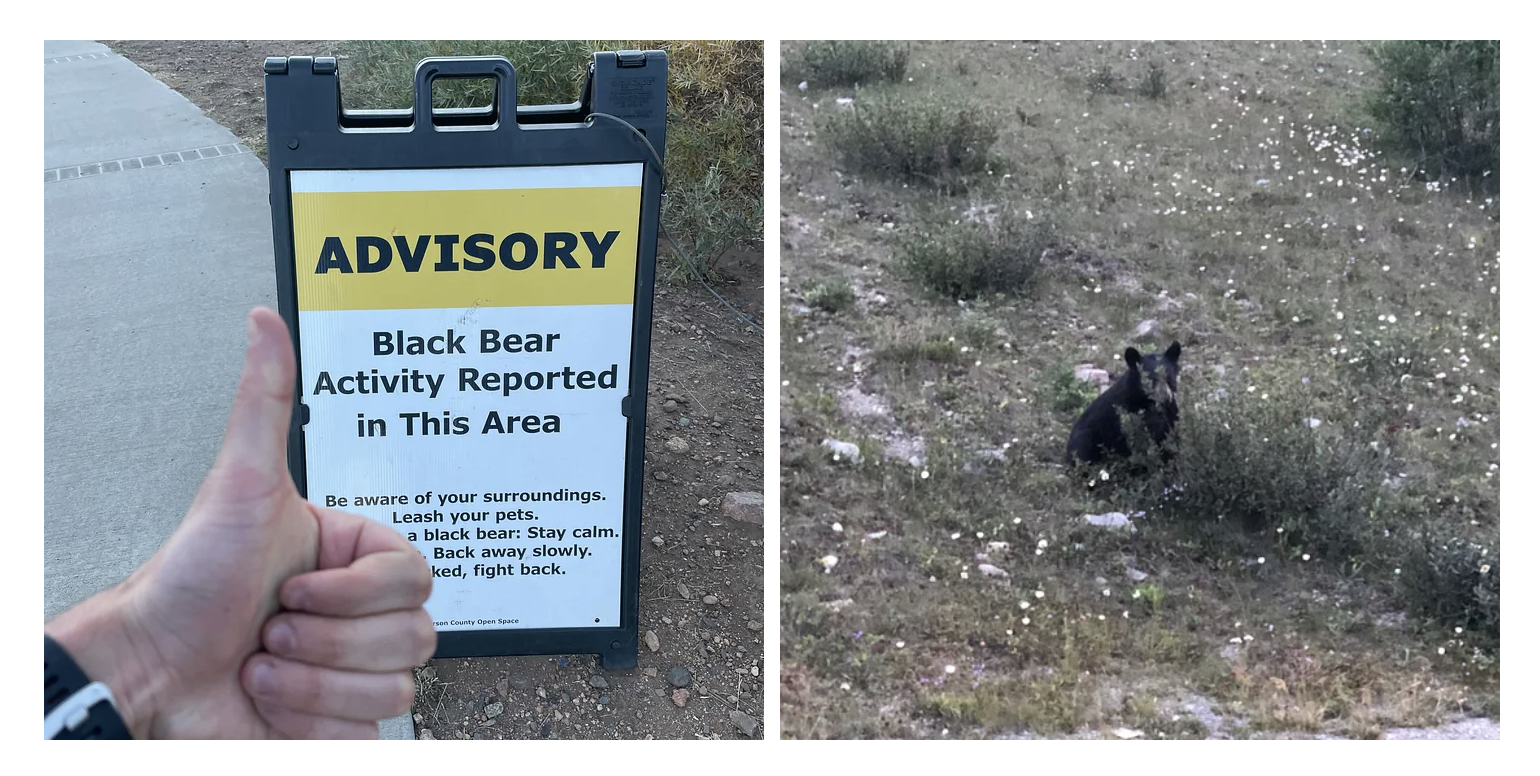
One other response that can arise from spiraling is the freeze response. During this process, the mind can feel foggy and it sends signals to the body that cause somatic responses such as heavy arms, feeling like there are 50 pound weights on our legs and other somatic effects that make it feel like our body is shutting down. Guess all that speedwork was for nothing 🙁
The beauty of this intense life-or-death response, from a bird’s eye view, is that we deeply care about something. In the bear example, it’s our survival. In the case of high pressure moments in sports, it’s due to the fact that YOU CARE about doing well. You care so deeply about something that it initiates this response. What a privilege it is to care this deeply about something. That’s pretty cool if you ask me!
The downside is that it is very detrimental to our performance if we don’t learn to handle it: our body tightens up, we lose mental clarity (feel frazzled), we become more reactive (worsens decision making), the volume of our negative self-talk skyrockets and we occasionally feel like quitting on the spot! As a junior tennis player, I wanted to run off the tennis court, go home, hug my dog and order some chinese food when this response arose. I didn’t want to waste my parents’ money, though (entry fees are high for tourneys), so I took the beatdown from my opponent and stayed mute for hours on the car ride home while my Mom seriously deliberated whether tennis was good for me.
So, what’s the antidote? Well, it all starts with awareness and acceptance. Many times, we don’t even realize we are spiraling. We are riding a rollercoaster we never knew we were on! So, we have to build the self-awareness to notice when our mind is in overdrive and moving at 1,000 miles an hour. Self-awareness is a muscle we develop through a meditation and mindfulness practice. More on that in another article.
Peak performance arises when our mind is in a state of relaxed concentration (also known as the flow state), not when it is jacked up with adrenaline and in a fight-or-flight response.
Once we are aware of the spiraling, rather than freak out about it (which only feeds the beast), we can then work on accepting where we are. I am stuck in the downward spiral. My body is tight, my heart rate is high, and I am afraid of the uncertainty ahead. Ok, I’m human! This is a natural human response and IT IS OK! Let’s work with it, with the guidance of these steps:
Step 1: Find moments to slow the game—or life—down. Take your time to mentally regroup whenever you have the chance. In tennis, it’s in between points. In a football game, before a snap or when you are on the sideline. In softball, between pitches. In the workplace, when your boss isn’t on your ass. There is ALWAYS a moment to slow the game down. You just have to look for it and take advantage of it.
Step 2: Use grounding tools to come back to the present moment, slow down your heart rate, and settle down your nervous system. Take a deep breath. Feel your feet on the ground. Visually take in your surroundings. Smell your armpits (or use your smell sense in another way). All of these are ways to ground yourself in the present moment. We highly recommend using breathing techniques because the breath is always there, from the moment we are born till the day we pass. Coming back to the breath is like coming back home to our cozy couch.
When you shift your focus to either the breath or your 5 senses, it helps your mind UN-ATTACH from the storyline fueling the spiral and shift the mind’s focus back to the present moment — the strongest tool we have for letting go of or slowing down the spiral.
Step 3: Not so fast, don’t expect the spiral to suddenly end. Be patient with yourself. As you use these grounding tools, you may notice the mind going back to spiraling. It’s ok. This is what working with the mind is all about. The more times we notice the spiral and then intentionally shift our focus back to the present, the more reps we are getting in the mind gym. We are strengthening the muscle in our mind that allows us to let go of the storylines in our head (that cause the spiral) and return to the present moment. The more you practice this, the more mental strength and resilience you’ll develop. The most resilient athletes are not those who don’t experience fear, they are the ones that best respond to fear. They are the ones that can consistently come back to the present, over and over and over again.
Always remember, mental resilience doesn’t mean you can block the spiral from happening, it means you know how to work with it gracefully.
Step 4: Use the downward spiral to learn more about yourself when you have a moment to reflect. Ok, the downward spiral “beats” you one day. All good, let’s look at what caused it. Why do we latch onto these thoughts and feelings? Is there anything in my history as a human that makes me more susceptible to these types of spirals? Was there anything in my environment that has caused me to have a certain sensitivity? Approach it with curiosity rather than self-judgment. You are NOT A LOSER for spiralling.
All of this is easier said than done. Spiraling sucks. It’s not fun and it affects our performance! However, if we can build a more compassionate and curious relationship with it, we can work with it.
The downward spiral isn’t our enemy. It’s our teacher and our friend. We just need to reframe our relationship to it and embark on the journey of learning how to ride the spiral. If we try to suddenly break the spiral, it’ll only take us for a longer ride.
I have experienced many downward spirals and still do. Sometimes mini ones, sometimes ones that feel so overwhelming that it feels like I’m drowning and make it difficult for me to function.
After my Freshman year of college I had my first major depressive episode. It was one of the scariest and longest lasting spirals I’ve ever experienced. My spiraling mind told me I was hopeless, not good enough, a failure, and even led me to question whether it was worth being here anymore.
In that spiral, it was my community—my ‘tribe,’ as Eric says—that pulled me out. We can’t always do it alone, which was hard for me to accept due to my mental wiring of what “mental toughness” is. I needed others to encourage me to hang on, to keep taking one step forward, promising me that the spiral was impermanent and that everything would be okay—even when it felt like it never would be. Reassurance that this is part of being human and that I CAN WORK WITH IT.

Brandeis Men’s Tennis was a part of my “tribe” in college
That’s the beauty of being human. We can work with our minds. Sadness, fear anxiety, doubt, jealousy, uncertainty, grief and all of our feelings are WORKABLE. It took me a while to realize that 1) I’m not inherently defective and 2) these uncomfortable feelings have some of the most powerful lessons to teach us if we create space for them without judgement. The same goes with our mental downward spirals: if we take an open, nonjudgmental approach to them, we’ll see that they offer us the opportunity to work on our mental strength and self-compassion everyday.
If it weren’t for these downward spirals, and my tribe, I wouldn’t have the tools to manage the hardest moments in life. Without them, I also wouldn’t experience the pure joy I feel when my mind is free from the spiral. I wouldn’t experience the pure joy of simply being.
That’s one of the silver linings of the downward spiral. Another is that it gives us the opportunity to learn how to sit with discomfort, explore it and get sort of friendly with it. From this perspective, our downward spirals turn from enemies into friends along our paths of self growth. Friends that push us to deeper inner work and self-discovery. Friends that, just like our loved ones, are there to help you grow. So maybe give our friend “The Downward Spiral” a chance to show you what they got, because maybe, it’s just what you need to take your next step forward. Or two steps backwards so that you can then take an even bigger step forward :)
Spiral on,
Ethan